
Employee Turnover Rate Calculator: Measure Your Workforce Stability
TL;DR: This guide explains how to calculate your employee turnover rate to measure workforce stability. The key takeaway is that tracking both voluntary and involuntary departures helps identify costly management and cultural issues. You should use a turnover rate calculator to quickly analyze your retention data and implement strategies to keep your best talent.
Indeed, you already know that retaining top talent is crucial for long-term business success. However, manually tracking how many people leave your company can be confusing and prone to mathematical errors. By using a turnover rate calculator, you can instantly measure your workforce stability and make smarter retention decisions.
Key Takeaways
- The employee turnover rate measures the percentage of workers who leave a company over a specific period.
- A healthy turnover rate generally hovers around 10 percent, though this varies widely by industry.
- You can calculate this metric by dividing the number of departures by your average employee count, then multiplying by 100.
- Tracking both voluntary and involuntary departures helps identify underlying workplace culture or management issues.
- Using an online calculator eliminates mathematical errors and provides instant, actionable human resources data.
What Is an Employee Turnover Rate?
An employee turnover rate is the percentage of employees who leave an organization during a specific time period. This metric includes both voluntary resignations and involuntary terminations. Tracking this number helps businesses understand workforce stability and evaluate overall employee satisfaction.
First, you need to understand why this metric matters. Employee turnover is a direct reflection of your company culture and management effectiveness. For example, a toxic office environment will consistently drive away your most talented engineers.
Additionally, tracking this number over time reveals important seasonal trends. Many businesses experience natural spikes in resignations during specific months. For example, retail stores often see massive staff exits immediately after the busy holiday season ends.
Why Is Employee Turnover Important?
Employee turnover is important because replacing staff is incredibly expensive and disrupts overall productivity. High departure rates often signal deeper issues with workplace culture, compensation, or management practices. By monitoring these numbers, you can fix problems before you lose your best talent.
Specifically, losing an employee costs a significant amount of money. The recruitment, onboarding, and training processes require major financial investments. For example, replacing a salaried worker can cost up to nine months of their annual pay, according to the Society for Human Resource Management. Consequently, keeping your turnover low directly protects your profit margins.
Moreover, frequent departures severely damage team morale. Remaining workers often have to take on extra tasks while a position remains vacant. For example, a marketing team of three might have to do the work of five people after two sudden resignations. This increased workload can lead to burnout and trigger a chain reaction of more resignations.
How Do You Calculate Employee Turnover Rate?
You calculate the employee turnover rate by dividing the number of separated employees by the average number of employees, then multiplying the result by 100. This standard formula works perfectly for monthly, quarterly, or annual timeframes.
Next, you must gather accurate headcount data before doing any math. You need the starting employee count, the ending employee count, and the total number of departures. For example, a company starting with 100 workers and ending with 110 workers has an average headcount of 105. This average forms the mathematical foundation of your calculation.
The Turnover Rate Formula
First, let us look at the exact mathematical equation. The standard turnover rate formula is straightforward and universally accepted by human resources professionals.
Employee Turnover Rate = (Number of Separations / Average Number of Employees) * 100
Additionally, you need a sub-formula to find that average employee number.
Average Number of Employees = (Starting Headcount + Ending Headcount) / 2
Consequently, combining these two equations gives you a complete picture of your workforce changes.
Manual Calculation Steps
Furthermore, solving this equation manually requires three simple steps. First, you determine your average workforce size for the chosen period. Next, you divide the total number of departures by that average number. Finally, you multiply that decimal by 100 to get your final percentage.
To illustrate, imagine you lost 5 employees in a month where your average headcount was 50. You divide 5 by 50 to get 0.10. Then, multiplying 0.10 by 100 gives you a 10 percent monthly turnover rate.
Turnover Rate Examples
Similarly, let us explore a realistic annual scenario. A retail store starts the year with 200 employees. During the year, the store loses 40 workers. By December, the store ends the year with 220 employees.
First, we find the average headcount by adding 200 and 220, which equals 420. Dividing 420 by 2 gives us an average of 210 employees. Next, we divide the 40 departures by 210, which equals 0.19. Multiplying by 100 yields an annual turnover rate of 19 percent.
What Is a Good Employee Turnover Rate?
A good employee turnover rate is generally considered to be 10 percent or lower across most standard industries. However, an acceptable rate heavily depends on your specific sector and business model. Retaining 90 percent of your staff usually indicates a healthy, stable, and highly engaged workforce.
That being said, context matters immensely when evaluating your numbers. Certain sectors naturally experience higher churn rates due to seasonal work or lower average wages. For example, the hospitality industry often sees annual turnover rates exceeding 70 percent. In contrast, government agencies typically maintain annual rates well below 20 percent.
Industry Average Statistics
Specifically, benchmarking your company against competitors provides the best perspective on your performance. The US Bureau of Labor Statistics carefully tracks these averages every year. Let’s take a look at the average monthly employee turnover rates across different US industries in 2024.
| Industry | Average Monthly Turnover Rate |
|---|---|
| Government | 1.4% |
| Finance and Insurance | 1.9% |
| Manufacturing | 2.7% |
| Healthcare | 3.0% |
| Construction | 3.9% |
| Retail | 4.0% |
| Leisure and Hospitality | 5.6% |
Additionally, you should always aim to stay below your specific industry average. By doing this, you can ensure your business remains highly competitive in the local labor market.
What Is the Difference Between Voluntary and Involuntary Turnover?
Voluntary turnover occurs when employees willingly choose to resign from their positions, whereas involuntary turnover happens when an employer terminates an employee. Tracking both types separately helps pinpoint exactly why your workforce is shrinking.
Understanding Voluntary Turnover
First, voluntary departures are usually the most concerning metric for human resources teams. These exits happen when workers leave for better pay, career growth, or improved work-life balance. For example, a software engineer might resign to accept a higher-paying role at a rival tech firm.
Furthermore, high voluntary churn often indicates systemic management problems within your organization. If your top performers keep leaving, you might need to evaluate your compensation packages. For example, offering a competitive benefits package can quickly stop a mass exodus of senior staff.
Understanding Involuntary Turnover
Conversely, involuntary departures are initiated entirely by the company itself. This category includes firing underperforming staff or conducting company-wide layoffs. For example, a factory might lay off 50 workers after losing a major manufacturing contract.
Admittedly, some involuntary churn is necessary to remove toxic employees. However, too much involuntary turnover can signal deep hiring flaws. For example, if you constantly fire new sales representatives within their first month, your interview process is likely failing.
What Are the Main Causes of High Employee Turnover?
The main causes of high employee turnover include stagnant wages, poor management, and a lack of career advancement opportunities. Additionally, toxic workplace cultures and heavy workloads frequently drive top talent away. Identifying these root causes is the absolute first step toward fixing your retention strategy.
Primarily, employees will inevitably leave if they feel undervalued or underpaid. Compensation remains a primary driver of job satisfaction across all major industries. For example, a worker earning below market rate will likely jump to a competitor offering a 20 percent raise.
Moreover, bad managers are a massive catalyst for sudden resignations. People often quit their bosses rather than quitting their actual companies. For example, a micromanager can easily push a highly productive graphic designer to resign in frustration. Consequently, investing in leadership training can drastically reduce your churn rates.
How Do You Use the Calculatorspedia Turnover Rate Calculator?
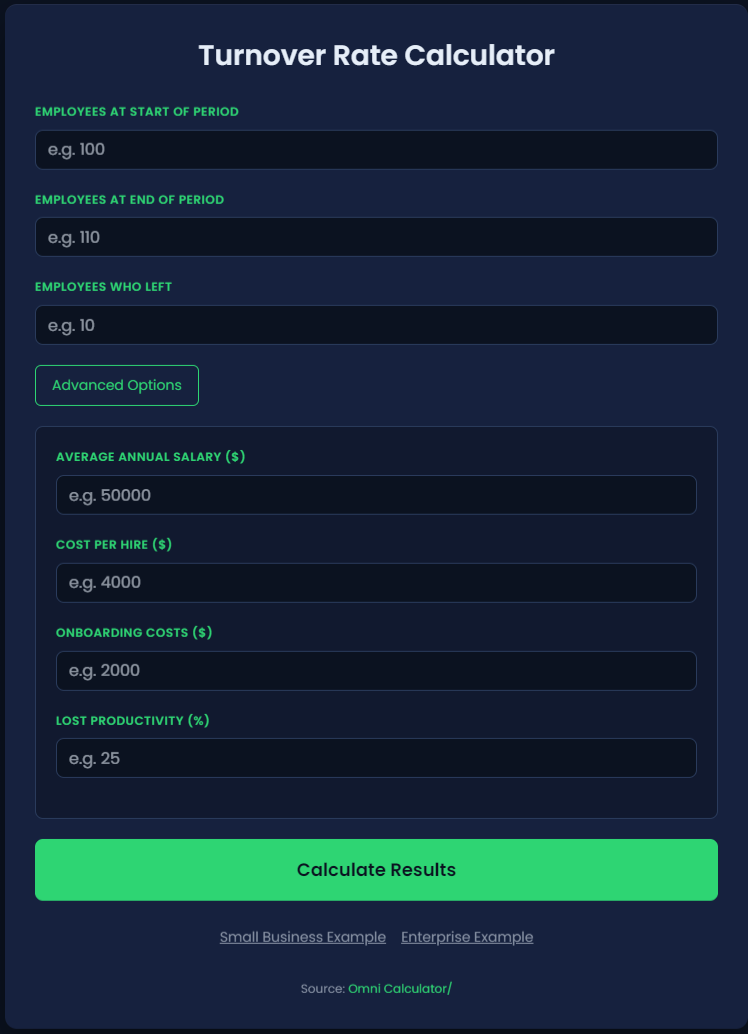
You use the Calculatorspedia turnover rate calculator by simply inputting your starting headcount, ending headcount, and total employee departures. The tool instantly computes your average employee count and final turnover percentage. This eliminates manual math errors and saves valuable administrative time.
Specifically, this calculator is designed to provide precise results based on verified human resources formulas. The tool is built to help students, engineers, teachers, and everyday users perform calculations quickly without needing manual formulas. For example, an HR manager can calculate monthly retention metrics in seconds instead of wrestling with complex spreadsheets.
Plus, using our free online tool ensures absolute accuracy for your quarterly reports. You can easily plug in different numbers to forecast future workforce scenarios. We also recommend exploring our other business management tools. For example, you can calculate your project timelines using our simple date tools.
What Are the Next Steps for Improving Retention?
The next steps for improving retention include analyzing your turnover data, conducting exit interviews, and enhancing employee engagement. Once you know your turnover rate, you must identify the root causes of departures. Implementing targeted retention strategies will help stabilize your entire workforce.
First, you should start conducting thorough exit interviews with all departing staff members. These conversations reveal honest, unfiltered feedback about your company culture and management flaws. For example, if multiple exiting workers complain about low pay, you know you need to immediately adjust your salary bands.
Additionally, investing in employee development drastically reduces voluntary resignations over time. Workers desperately want clear career progression and ongoing training opportunities. For example, offering a junior analyst a clear path to a senior role will dramatically increase their long-term loyalty.
Use our Sales Discount Calculator to quickly calculate discounted prices and savings on your purchases.
Conclusion
In summary, tracking your workforce stability is essential for long-term business growth and profitability. The employee turnover rate is a vital metric that highlights the overall health of your company culture. By regularly calculating this number, you can spot retention issues early and take immediate corrective action.
Therefore, you should make data-driven decisions to protect your bottom line and keep your best workers. We heavily encourage you to use the turnover rate calculator on calculatorspedia.com today. By doing this, you can build a happier, more stable workplace for everyone!
Written by: Riya Sharma Financial Analyst CFA, MSc Finance
Reviewed by Arjun Menon Chartered Accountant CA, MBA Finance
Disclaimer: This article was initially drafted using AI assistance. However, the content has undergone thorough revisions, editing, and fact-checking by human editors and subject matter experts to ensure accuracy.